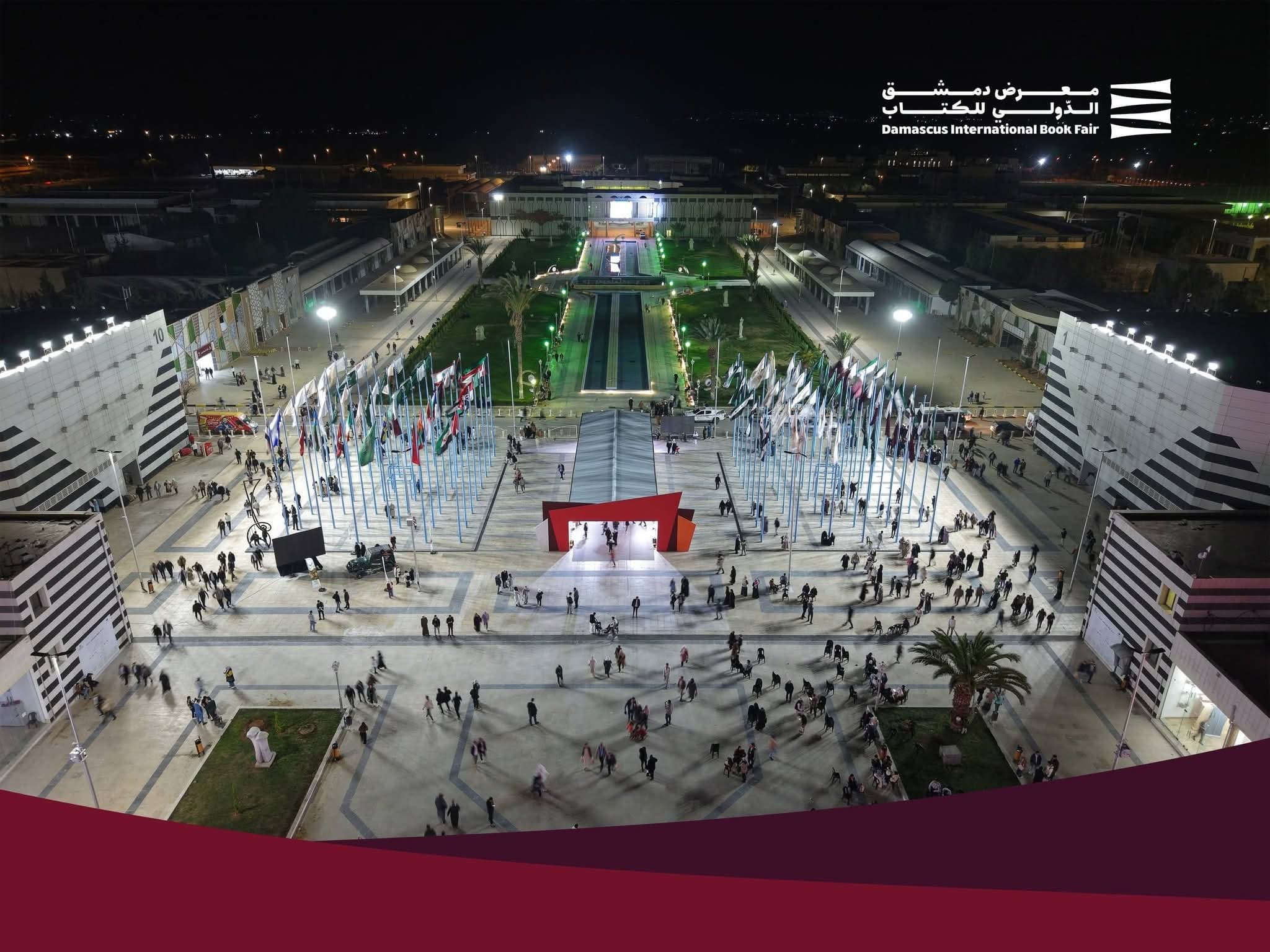
Departure points of public transport buses from Damascus city to the Damascus International Book Fair at the Exhibition City. We look forward to welcoming you at the largest cultural event in Syria 📚
Seminar Title: “Twinning between Arabs and Kurds since Antiquity” An in-depth reading into the roots of the historical and cultural relationship between Arabs and Kurds— a relationship of interaction and civilizational interweaving that contributed to shaping Syria’s diverse social and cultural fabric, and reinforced the values of coexistence across the ages. 📍 Venue: Syrian National Library 🗓 Date: Wednesday, January 28, 2026 ⏰ Time: 2:00 PM 🎟 Open Invitation
The Minister of Culture conducted a tour in Deir ez-Zor Governorate that included the Directorate of Culture and the National Museum, in addition to crossing the river to the Hajin area. During the visit, the Minister and the accompanying delegation reviewed the current state of cultural infrastructure and its needs, and held a number of meetings with tribal elders and community representatives, emphasizing the importance of activating cultural centers and revitalizing cultural, intellectual, and artistic activities, so that the efforts of cultural institutions integrate with society and its aspirations. The Minister and the cultural delegation also offered their condolences to the families of the two children, Omar Al-Anawi and Othman Al-Habbal, who were martyred in Hajin as a result of the explosion of a landmine left over from the remnants of “SDF.”
The Ministry of Culture announced the completion of restoration work on the eighth tower of the Damascus Citadel, in cooperation with the European Union and the Italian organization COSV. The Ministry also launched the Syrian Heritage House project within the Damascus Citadel, as part of an initiative aimed at protecting Syria's tangible and intangible cultural heritage and reintroducing it in an interactive space that strengthens its presence in society. The project, implemented in cooperation with the Italian organization COSV and the European Union, aligns with the Ministry's vision of revitalizing archaeological sites and transforming them into open cultural spaces. The inauguration ceremony was attended by Minister of Culture Mohammed Yassin Al-Saleh, Italian Ambassador to Damascus Stefano Ravagnani, EU Representative to Syria Agne Gleickeå, Director General of the Italian organization COSV Paolo Comoglio, and representatives from the local community.
"The Ministry of Culture, in cooperation with the Italian organization COSV, completed the project 'Syrian Heritage House,' aimed at reviving Syrian cultural heritage and presenting it within an interactive space that strengthens its presence in society. The project consists of transforming Tower No. 8 in Damascus Citadel into a multifunctional interactive cultural space dedicated to introducing both tangible and intangible Syrian cultural heritage, by linking it to the living memory of society and its daily practices. The implementation of the project included restoration work on the tower and the main gate leading toward the Al-Asrouniya market, along with cleaning and maintenance activities, as well as a study of the possibilities for rehabilitating the adjacent garden. The work on the project, which spanned several months, will culminate in its inauguration on Monday and Tuesday, January 26 and 27, 2026, at its location in Damascus Citadel. A permanent visiting schedule will later be set, along with a program of accompanying cultural activities."
The Ministry of Culture signed a cooperation agreement with the Syrian Heritage Forum, Riwaq, aimed at supporting the documentation of Syrian tangible and intangible heritage and strengthening efforts to preserve and make the national cultural memory accessible to the public. This cooperation comes within the framework of supporting serious cultural initiatives that work to document heritage as an integrated fabric combining tangible artifacts and intangible narratives, presenting it within scientific and ethical approaches that respect the rights of individuals and communities who bear the heritage. The agreement stipulates strengthening coordination and cooperation in the areas of documentation, research, and cultural programs, and facilitating fieldwork within legal frameworks, thereby contributing to the protection of Syrian heritage, establishing its attribution, and making it accessible as a living memory available to all. Both parties emphasized the importance of integrating official efforts with independent cultural work, in a way that serves the public interest and preserves Syrian heritage for future generations.
Minister of Culture, Mohammad Yassin Al-Saleh, received a delegation from the Turquoise Mountain International Organization, headed by its president, Ms. Shoshana Stewart, and including British politician and academic, Mr. Rory Stewart. The two sides discussed prospects for joint cooperation to revive Syrian cultural heritage and traditional crafts. Ms. Stewart presented a detailed overview of the organization's work. Founded in 2006, Turquoise Mountain operates in several countries in the region, focusing on three main areas: training artisans, restoring historical sites, and providing global markets for handcrafted products. The delegation expressed the organization's desire to establish a strategic partnership with the Ministry of Culture and open an office in Damascus. The aim would be to conduct specialized workshops for Syrian artisans and contribute to projects restoring archaeological and historical buildings. For his part, the Minister of Culture reviewed the organization's successful experiences in Jordan and Saudi Arabia, emphasizing that protecting and developing Syrian craft heritage is a priority for the Ministry. He directed that the proposed cooperation be studied in depth through official channels to determine the framework for a possible partnership that serves Syrian cultural heritage.
Minister of Culture, Mohammad Yassin Al-Saleh, received a delegation from the World Bank, headed by Dr. Catherine Tufey, Director of the Urban Practices, Disaster Risk Management, Resilience, and Land Sector for the Middle East and North Africa region. The meeting focused on ways to develop cultural and institutional work and enhance cooperation. Minister Al-Saleh emphasized the pivotal role of the Ministry in promoting social stability, highlighting the "Homs Wednesday" initiative as a successful model of community work. This initiative launched fundraising campaigns across various Syrian governorates. He also mentioned the "Cultural Bus" project, which aims to bring culture to rural and remote areas. For her part, Dr. Tufey, the World Bank representative, commended the cultural and community initiatives presented and expressed interest in exchanging expertise and collaborating in the areas of capacity building and developing cultural work models with developmental and social dimensions.
The Rida Saeed Conference Hall at Damascus University hosted an international workshop that addressed the current state of Syrian archives and the challenges they face, both past and future. The workshop was held under the auspices of the Ministries of Culture and Higher Education and Scientific Research, in cooperation with Damascus University and the Syrian Archives Initiative. Academics and researchers from Syria and several Arab and international countries participated. The sessions addressed the archives crisis in the absence of a legal framework and a specialized national institution, the necessity of establishing a public authority for national archives, the protection of historical archives, and the recovery of state documents not currently used administratively. Comparative international experiences were also reviewed. Attendees included the Minister of Culture, Muhammad Yassin Al-Saleh, the Minister of Higher Education and Scientific Research, Dr. Marwan Al-Halabi, several deputy ministers, deans of faculties, and specialized academics and researchers.
قام وزير الثقافة، محمد ياسين الصالح، بتفقد مواقع جمع التبرعات لحملة "الولاء للشام لأهلنا في المخيمات"، واطلع على سير العمل والجهود المبذولة لتوفير مواد التدفئة والاحتياجات الأساسية للأسر في مخيمات شمال سوريا. واجتمع الوزير مع القائمين على الحملة، مشيداً بمبادرات التضامن المجتمعي التي تعكس روح التضامن والمسؤولية الوطنية، ومؤكداً على دور الثقافة في دعم القيم الإنسانية وتعزيز المشاركة المجتمعية.
Minister of Culture, Mohammad Yassin Al-Saleh, received Syrian scientist and inventor Dr. Adnan Wahoud, holder of 76 patents in textile science. Dr. Wahoud introduced the art of Damascene weaving to Germany and the Western world and founded the model village of Al-Toubat in Idlib Governorate. The Minister emphasized the importance of expanding the Al-Toubat village model under the auspices of the Syrian state, to benefit from Dr. Wahoud's experience in preserving heritage and humanitarian work, and to empower displaced persons with housing, employment, and education. Dr. Wahoud also presented his experience based on the "social housing" model in Germany and gave the Minister a book documenting his scientific and humanitarian career, along with the manuscript of his book "The Last Weaver," which will be published under the auspices of the Ministry of Culture, as per the Minister's directives.
We were, are, and will remain committed to a unifying Syrian national discourse, rejecting hatred, discrimination, and all the remnants of the former regime, including its bigotry, racism, and sectarianism. During a previous visit to the city of Afrin in the Aleppo countryside, Minister of Culture Mohammed Yassin al-Saleh emphasized that the Arab and Kurdish peoples form a historical unity, sharing a common culture and heritage, and bound together by a unified national framework.
Minister of Culture Mohammed Yassin Al-Saleh received the Jordanian Ambassador to the Syrian Arab Republic, Sufian Al-Qudah, and during the meeting, the importance of strengthening joint cultural cooperation was emphasized in line with the depth of relations between the two brotherly countries.
Minister of Culture, Mohammad Yassin Al-Saleh, and President of Damascus University, Dr. Mustafa Sa'im Al-Dahr, signed a memorandum of understanding to enhance institutional cooperation in the fields of libraries, manuscripts, training, digital projects, and databases, in support of the digital transformation process. The memorandum includes the restoration of manuscripts, the allocation of a section for Damascus University manuscripts within the National Library, the exchange of information resources, training for librarians, and the organization of joint workshops. The memorandum also stipulates participation in international databases and the standardization of classification and cataloging criteria to develop the national knowledge infrastructure. A joint committee will be formed and will meet every six months to monitor implementation and evaluate performance. The memorandum is valid for two years and is renewable.
Highlights of the Ministry of Culture's work during December 2025.
Minister of Culture, Mohammad Yassin Al-Saleh, held a meeting with the directors of the Syrian cultural directorates, dedicated to the general cultural direction for 2026. This conference brought together cultural creators for 2026, along with a number of prominent figures in the field of cultural work and its defining characteristics. They established a constructive vision for creative research on freedom and creativity, and a significant cultural contribution within society. The conference also discussed formulating a diverse cultural narrative and extending the authentic scientific framework.
Imad Al-Armashi (1951–2025) A Syrian researcher and historian born in Damascus, specializing in its urban history, and one of the most prominent figures interested in documenting its historical and human heritage. Imad Al-Armashi was born in 1951 and grew up in the Souq Sarouja neighborhood of Damascus, which instilled in him an early connection to the city and its landmarks. He graduated with a degree in history from Damascus University in 1977. Since 2003, Al-Armashi has dedicated himself significantly to documenting the history of Damascus, working to collect a vast number of documents and references that reveal its neighborhoods, markets, mosques, schools, Sufi lodges, caravanserais, and prominent families, in addition to clarifying the urban transformations the city has witnessed over the decades. The passing of Imad Al-Armashi is a loss to the research and cultural scene in Damascus. Moreover, the visual and intellectual archive and documented studies he left behind remain a valuable asset for future generations, and a testament to his utmost efforts in preserving the city’s memory and defending its historical presence in the public consciousness.
The Central Bank of Syria launched the new national currency today, its symbols and meanings inspired by the unifying Syrian identity. This reflects the cultural dimension of national sovereignty and reinforces the Syrian pound's role as a symbol of belonging and national consciousness. This launch underscores the interconnectedness of culture and economics, as the national currency constitutes a component of collective memory and represents a new phase in which Syria seeks to solidify the values of belonging and pride in its identity as the foundation for building the future.
The memorandum aims to organize areas of cooperation between the two parties, enabling the Syrian Cultural Center to become a specialized incubator for cultural activities. This will contribute to supporting creative initiatives, enhancing institutional development and digital transformation, and building human capacity within the cultural sector. This step aligns with the Ministry of Culture's vision of developing mechanisms for cooperation with cultural initiatives and institutions, thereby supporting the advancement of the cultural landscape and strengthening its presence both locally and internationally.
The Ministry of Culture hosted a lecture titled "The Compass of Success," presented by Dr. Muhammad Issam Mahou, at the Damascus Opera House. The lecture drew a significant audience interested in self-development and professional success. It highlighted key perspectives, concepts of success, self-management, and cultivating diversity, offering attendees practical knowledge that combined in-depth experience with practical insights. The lecture also addressed tools to help individuals find a clearer path toward achieving success and excellence in various aspects of life.